Menu

Show posts

This section allows you to view all posts made by this member. Note that you can only see posts made in areas you currently have access to.

Show posts Menu

Messages - A. Pel

#1
Alliums / Re: Potato Onion Report 2026
2026-10-23, 04:44:46 AM
Quote from: Tim DH on 2026-10-23, 01:10:15 AMSome day I'd like to move away from onion sets, partly because I suspect that they are an occasional source of White Rot, and partly to be more self reliant.

I certainly think that. I am quite paranoid about onion diseases and avoid importing bulbs.

Growing from seed works well for me. Last year I conducted an experiment in the autumn (about now actually) and just scattered onion seed on a newly cleared bed of an unheated greenhouse and loosely smoothed it over to bury the seed. I save the seed from my onions so I have lots for an experiment like that. It certainly worked out well. The onions germinated and slowly grew during the warm days of the winter. The frosty cold days did not bother them. By the time spring arrived I had a veritable forest of well rooted onion starts in the bed - all about the size and thickness of a pencil. I let them run until I needed the bed for something else and then transplanted them out.

Quote from: Tim DH on 2026-10-23, 01:10:15 AMWhat are your thoughts on productivity? Is a 5 clump line twice as productive as a 3 clump line? What is your view of the ideal clump number?

My view is that the productivity is about the same. The roots of the original bulb can only draw so much in the way of nutrients and water from the surrounding soil so the maximum productivity plateaus at a certain level. Having said that, there are a lot of double two clumps that seem to reach the same size as my best five clump and stall there. So genetics does have an effect.

Quote from: Tim DH on 2026-10-23, 01:10:15 AMRegarding White Rot has your friend tried the Garlic Juice method?

I have suggested that but, strangely, he seems uninterested. Breeding some Onion White Rot resistant onions seems like a generally useful thing so that is where I will direct my interests.
#2
Alliums / Potato Onion Report 2026
2026-09-30, 10:10:53 AM
I have had quite a good year with my Potato Onion Resurrection project and have now posted the annual report. Lots of pictures and other details.

https://plantal.net/PotatoOnion2026Report.html

#3
Alliums / Re: Potato Onion Resurrection
2026-09-04, 06:11:11 AM
>Is seed of your named lines available in the USA?

Not from the Named Lines - I have never let them run to seed. I do have some 2025 seed from the Base Group left and am in the process of collecting the 2026 seed. I cannot send actual bulbs to the US (I am in the UK) but I can send some of that seed. Realistically, I don't think it will matter much if the seed came from the Named Lines or the Base Group - if the base group seed is planted out and culled as per the breeding methodology then, in about 2 or 3 years, Potato Onions equal to or better than my Named Lines should be present. The Named Lines I have now actually originate from seed harvested in 2023 - and the gene pool has improved since then.

If anyone would like seed please register your interest by sending a note to the email address on the page: https://plantal.net/About.html. No need to include personal details such as addresses just yet. Once I get the seed in I will send an email and we can work out how to get the seed to you.

>Following back to early history of your project, is it true that the beginning was when you let some material derived from potato onions cross with modern commercial biennial onions with everything you are working with now derived cytoplasmically from potato onions?

That is certainly possible but it is my belief that their genes are probably not the source of most of the splitty, clumping behaviour. In the early days, while I was trying to get the Potato Onions to work I was also Promiscuously Pollinating modern biennial onions together in an project to breed long keeping, long storing onions. Occasionally I would see splitty, clumping behaviour in some of the F2, F3.. generations there and separate them out. There were no heirloom Potato Onions in that mix. So, I guess the heirloom Potato Onion genes could be in the Base Group but I don't think they were the primary source of the Potato Onion-y behaviours. Given their reluctance to set seed I imagine their genetic contribution was modest - at best.

>One sometimes finds an occassional onion of just about any modern biennial variety with an onion that has split inside the wrapper leaves. What happens if you plant those? 

The onion will likely split. I have no idea what happens if the onions of the same type are crossed together. I suspect a certain percentage of the future generations would be increasingly Potato Onion-y.

>Can you select potato onions out of "pure" op varieties? I am thinking it would be nice to have potato onion lines that produced seed that gave you the same type of onion as the onion it came from instead of a big diversity.

I really don't know - all of my efforts were directed towards injecting diversity into the gene pool. The thinking was that anything that looked interesting could be propagated vegetatively and I would never need to worry about true-ing them up.

>It's possible that the the individual onions in modern biennial op varieties that show separate onions inside the wrappers are genetically different from the others, because there really aren't seriously pure varieties of onions. My understanding, personal communication from Irwin Goldman, plant breeder at University of Wisconsin-Madison and specialist in root crops such as carrots, beets, and onions, is the biennial root crops really hate being genetically homogeneous. So much so that even the "inbred lines" used to create commercial hybrids actually have a good bit of genetic heterogeneity in them. So it's possible that the double onions inside husks in common biennial op  varieties have a genetic cause and could be selected for to produce potato onions whose seed reproduced the type of the bulb. ???

That is very interesting and does correlate well with my, admittedly, anecdotal experience.

>I also wonder if you have done any selection of your material for scallions, use of the entire small onions including greens.

Every year I get some onions in the Category 1 group which are small and salad onion like. I keep them separate and plant them out in the hopes of getting a nice bunchy scallion/salad onion cultivar. So far, nothing very interesting has appeared in the second year. Here's hoping :-)
[/quote]
#4
Alliums / Potato Onion Resurrection
2026-08-30, 07:04:59 AM
Some interesting things have been happening with my Potato Onion Project. To better document things, the project has been moved to its own website (plantal.net: Plant Alchemy) and the content has been completely re-written.

Here is the main link: https://plantal.net/PotatoOnions.html

The project is called Potato Onion Resurrection. The word "Resurrection" is used in the project name because rather than attempting to convince the few existing Potato Onions to set seed, the breeding method works with modern biennial onions and essentially re-activates the latent splitty, clumping genes they contain. In the process, the formerly biennial onions have effectively become perennial. The Breeding Methodology page discusses this process in some detail:

https://plantal.net/PotatoOnionBreeding.html

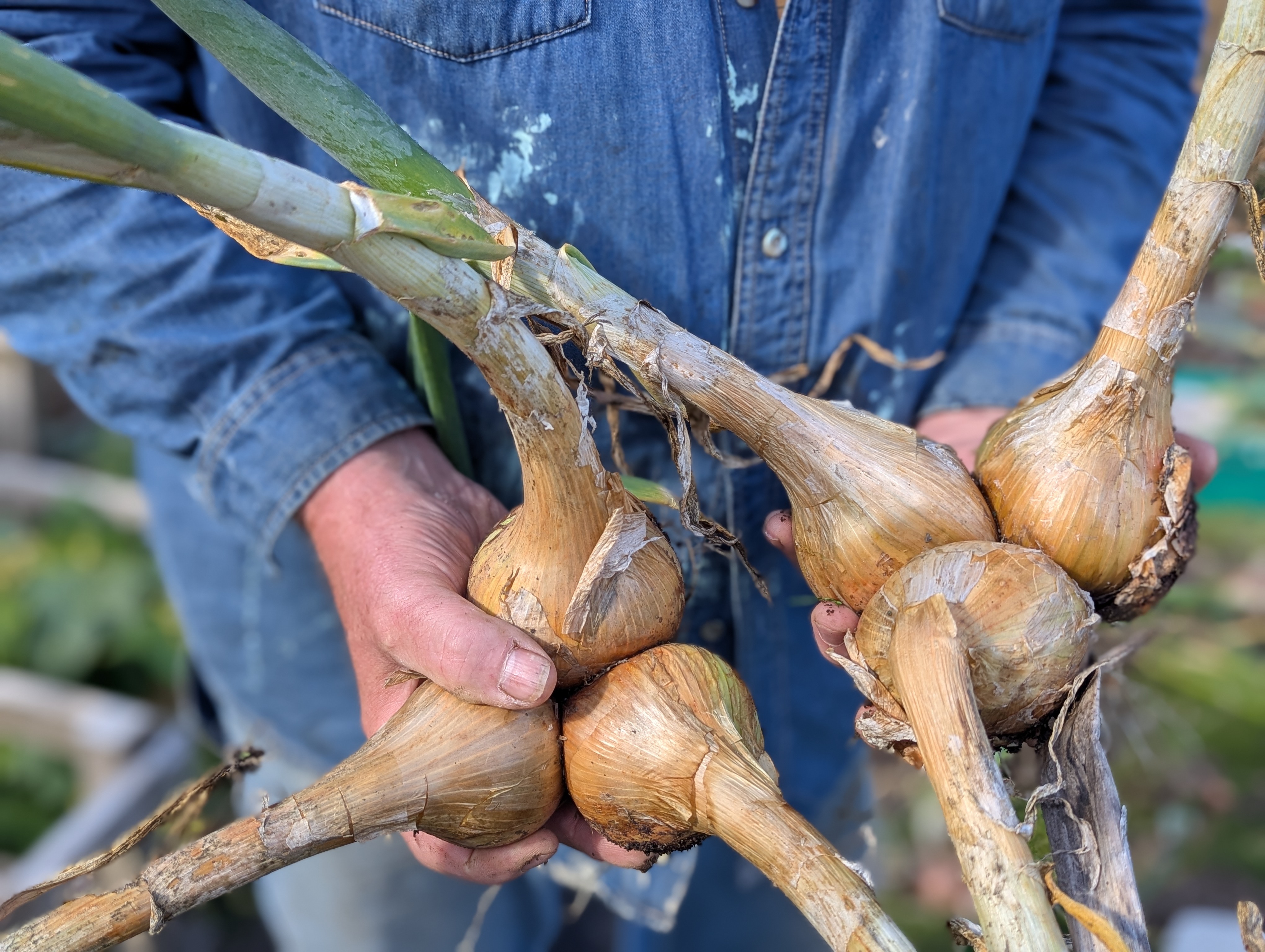
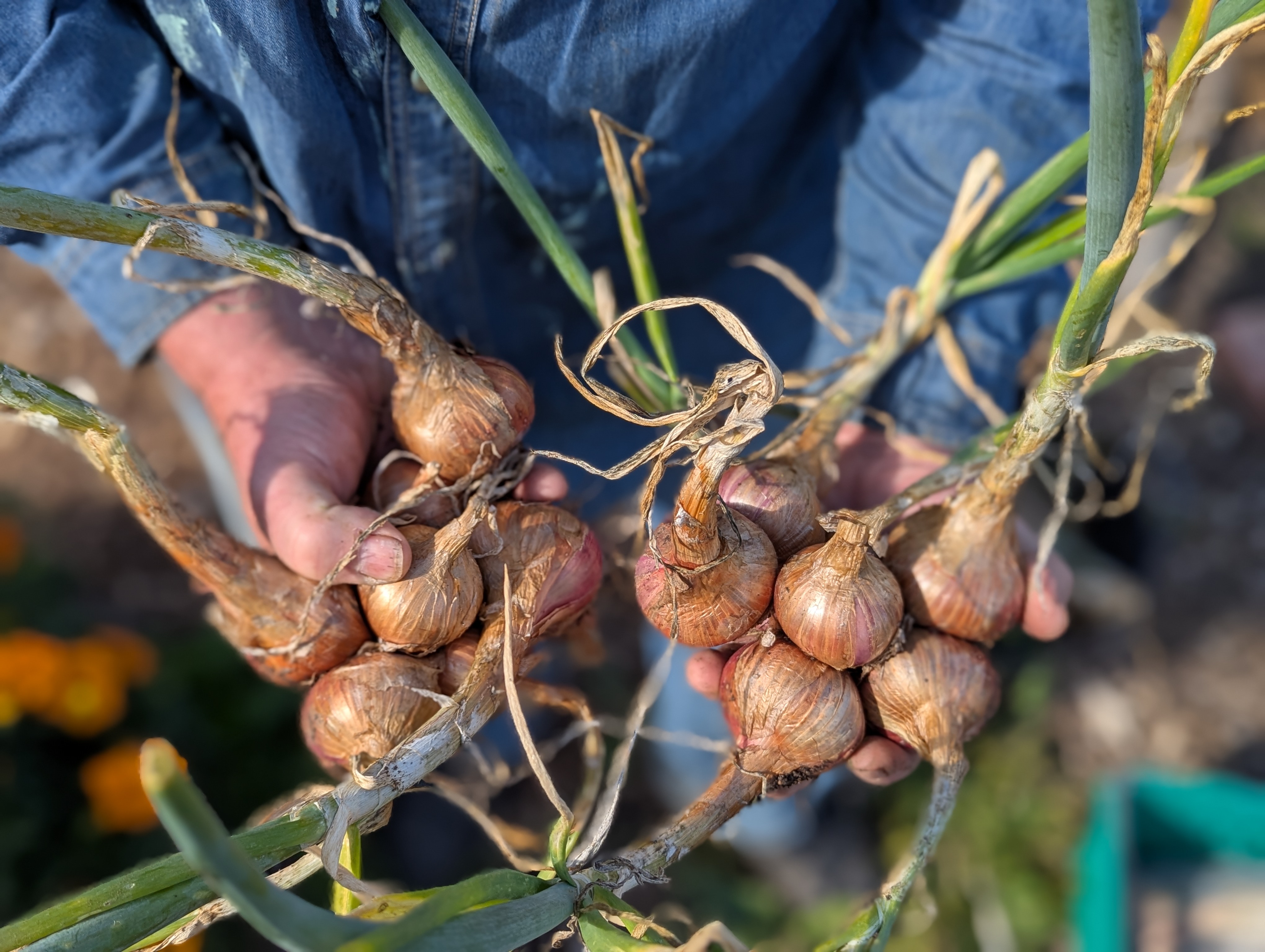
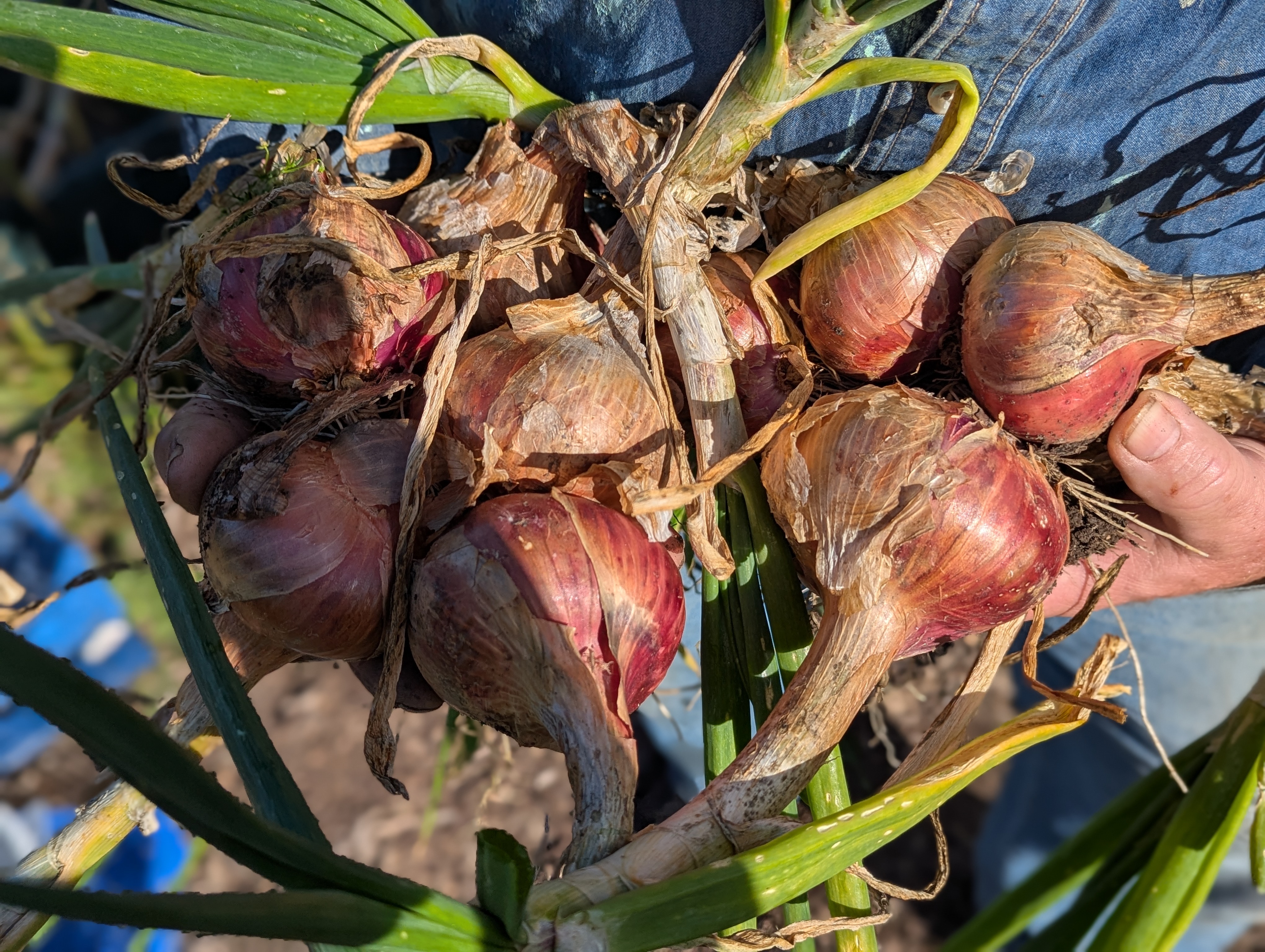
I am starting to get results. There are some images below, but I feel that one of the most important results is not the bulbs themselves - but the seed stock. The project has now developed a seed stock of extremely diverse onions that enthusiastically set seed and most (about 75%) of the resulting offspring will readily split.

All results are Open Source.

The Ariel 3 Named Line


The Juliet 7 Named Line


The Phoebe 5 Named Line

#5
Good work, very cool.

Please do post more results as you get them.
#6
Alliums / Re: Potato Onion Report 2025
2025-11-11, 12:09:08 PM
Quote from: whwoz on 2025-11-11, 12:51:50 AMDo you have shallots available to you.... 

I tend to think of shallots as heirloom French potato onions. However, they do tend to have a distinctive taste. Not bad, but different from regular onions.

In the early days, I considered using them to introduce splitting characteristics into the gene pool with the thought of breeding the taste back out but keeping the splitty-ness. I also considered doing the same with  spring onion/scallions etc. and then breeding the small size back out.

Ultimately, I decided to hold off for a year or two in order to see how things might settle out before taking drastic steps like that. I am quite pleased now that I did. At the time I took the notion that most single bulb onion types were probably descended from multiplier type ancestors. It turns out mongrelizing various common single bulb onion varieties by promiscuously crossing them with each other unlocked the latent "potato onion" genes that they were already carrying.

So the introduction of shallots was always an option - but one I was saving as a last resort. Interestingly, a small percentage of my onions come out as distinctly shallot like - so I'm thinking there are some shallot genes in there already.
#7
Alliums / Potato Onion Report 2025
2025-11-09, 04:47:33 AM
Well, I have had quite a good year on my Potato Onion Resurrection Project.

For those that don't know, Potato Onions (or multiplier onions) are onions that are bred to split into bunches of multiple bulbs from a single planted bulb. You then plant one of the bulbs back and eat the remainder - much like potatos (hence the name).

There are existing lines of heirloom Potato Onions but they have the reputation of rarely setting viable seed. This makes it very difficult to work with them from a breeding perspective. I am using selective breeding of various common onion varieties to produce a variety of onion with Potato Onion characteristics that will readily split and also set viable seed.

Here is a write up on this years progress: 2025 Potato Onion Report There is a lot more detail of the projects progress and goals on that page.

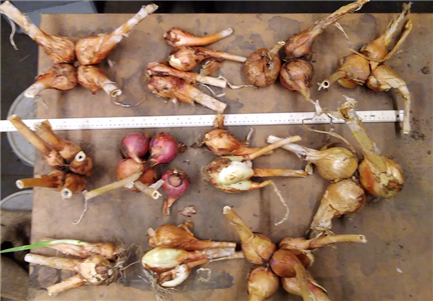
As an example here is a bunch of 4 - I now have about 11 bunches of 3 and 4 onions each. All of reasonable size.


Here is a pic of the 3 and 4 bunches for the 2025 season. The white bar in the middle is a measuring stick with both centimeter and inch markings.


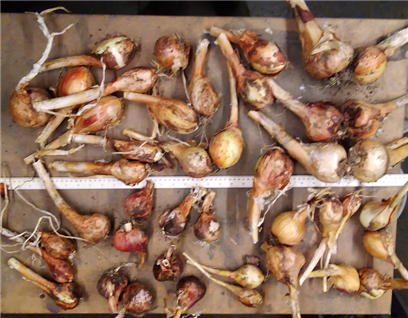
Here is a pic of the doubles (bunches with two onions)


#8
Quote from: Hana Yoshida on 2025-10-07, 12:43:58 PMPlease call me Hana Yoshida, Hana written with 華 and Yoshida with 芳田.

Welcome to the forum Hana. Keep us posted on the Taraxacum officinale - a very worthwhile project.

I'm pretty sure that the Soviets did a lot of work domesticating and breeding the dandelion in the 60's and 70's. Not sure what became of the results - probably all lost in the breakup.
#9
Corn / Re: UK Maize
2025-05-02, 01:19:19 AM
Very cool project!

Quote from: Tim DH on 2025-05-01, 03:15:59 AMShane's Parrot Proof is new to me. I'm curious, what feature makes it parrot proof? Not that its much of a problem for us in Yorkshire!

Parrot proofing might be a useful characteristic to have sooner or later. Budgies (Budgerigar) are a type of parrot and are notorious for eating seeds. There are reputedly 10's of thousands wild in London and they are moving further north every year
#10
Cucurbits / Re: A squash selection
2025-01-20, 02:29:54 AM
Beautiful squashes - and well documented. Good luck with the project
#11
I use wooden labels and just write on them with a felt tip pen. The marking lasts as long as the labels do - which is about 2 years in my rainy wet climate.
#12
Alliums / Potato Onion Report 2024
2024-10-28, 04:16:32 AM
Just wrote up the progress on my Potato Onion breeding project for 2024.

https://longkeepingapples.com/PotatoOnion2024Report.html

In summary, it has been a reasonably successful year. Last year I had about 14 reasonable potato onion lines, now I have about 20. They are still smaller than I would like - but I am actively looking to breed size into them in future generations.

It is interesting to note that all of the onion bunches below are generated from single bulbs that also set seed this year. The original bulb itself is gone but managed to produce both a scape and some new bulbs at the base. It appears that these lines might be replant style perennials - setting seed is definitely not the end of the plant. I intend to conduct experiments next season to see the effect on the bulbs of preventing the onions from setting seed. I have, of course, collected the seed - in past years the seed was quite viable and I think this years should be as well.


#13
Nice. My potato onion project is moving forward as well. Last year one bulb of a pair produced both top sets and seeds. They were smaller top sets than yours - similar to a small pea. Unfortunately all of the topset bulbs died out over last winter - they got too wet in the greenhouse and I did not rescue them in time. Very, very annoyed at myself for that.

No top sets this year - but lots of seeds. I'll post a report on this years progress once I get it organized.

https://longkeepingapples.com/PotatoOnions.html
#14
This is very, very interesting!

Never would have thought of using something like MSG to induce polyploidy or cement to assist with wider crosses. I look forward to reading the rest of the articles on that Substack as well.
#15
Grains / Re: Wide Cross Wheat Landrace Project
2024-10-15, 03:08:22 AM
Thank you for describing your breeding technique - very interesting and educational.